
Hall County Most Wanted List
Hall County posts its Most Wanted list on the sheriff's Police-to-Citizen portal. Gerald Couch has served as sheriff. To confirm who holds the office now, check the official sheriff's page. The list itself is selective. It helps residents put a name to a face and call in a tip. Entries are sorted by last name, not by date. Some carry photos and some don't. Updates follow no fixed schedule, so the top result is not automatically the newest warrant.
A wanted notice and a jail roster answer different questions. One tracks people the sheriff is hunting under a warrant. The other, the county inmate roster, shows who is actually in custody after a booking. A person can land on one list and not the other.
To see the current listings, open the official Hall County Most Wanted catalog. The photos there belong to the sheriff's office. Copying or reposting a face from the listing is not permitted. The interface shown below is just a navigation aid pointing to the live sheriff's source, not a gallery hosted on this site.
Treat the catalog as a starting point. Pair what you see there with direct contact to the agency before relying on any detail, since a web listing alone cannot tell you the current count or the final outcome of a case.
What Hall County Wanted Listings Show
A Hall County wanted entry can display a range of details about a person and the warrant behind the listing. Not every record fills every field, though. The portal decides what appears. Entries differ from one another. For anything that matters, compare the listing against what the agency itself reports.
| Field | What it may show |
|---|---|
| Name | The person's name as entered by the agency. |
| Photo | An image when HCSO supplies and enables one; availability is not universal. |
| Agency | The law-enforcement agency associated with the listing. |
| Warrant or charge information | The listed basis for the notice, not a final court finding. |
| Physical description | Descriptors such as race, sex, height, weight, or age when supplied. |
| Marks and alerts | Scars, marks, tattoos, or caution information when the record includes them. |
Listings can be wrong or stale. Names get misspelled. Photos age. Details drift out of date, and the posting can linger anyway. When accuracy counts, the agency's current information and the court file remain the fuller answer.
How to Read Hall County Most Wanted
The catalog has one purpose: recognition and reporting. It is not an invitation to confront anyone or play deputy. Keep the source, the date, and the person distinct from whatever you assume about the case behind the listing.
- Open the official Hall County Most Wanted Persons catalog and use its search or browsing controls.
- Read the name, agency, warrant or charge description, and physical details together.
- Check whether the entry supplies an alert or other caution before sharing information with law enforcement.
- If a person or location is recognized, use the official anonymous tip form or the Warrant Service Unit phone.
- For a person who may have been captured, use the county custody path described in the Hall County booking and arrest search, then verify with HCSO.
Hall County Warrant Tips and Safety
HCSO takes tips two ways: through its anonymous warrant-tip form and by phone through the Warrant Service Unit at 770-531-6907. The form asks for the suspect's name and location, while fields for the tipster's own contact information stay optional. No reward is advertised, and there is no Crime Stoppers offer attached to this route.
1700 Barber Road, Gainesville, GA 30507
770-531-6907
The unit maintains and serves arrest warrants, arrest orders, probation or parole warrants, and bench warrants.
Accuracy matters when you call. A false report carries its own legal consequences, and a tip never substitutes for official confirmation of a warrant. For a current question, the listed phone and agency route are the right tools.
The official Warrant Service Unit information appears below. It covers the unit's role and how to reach it.
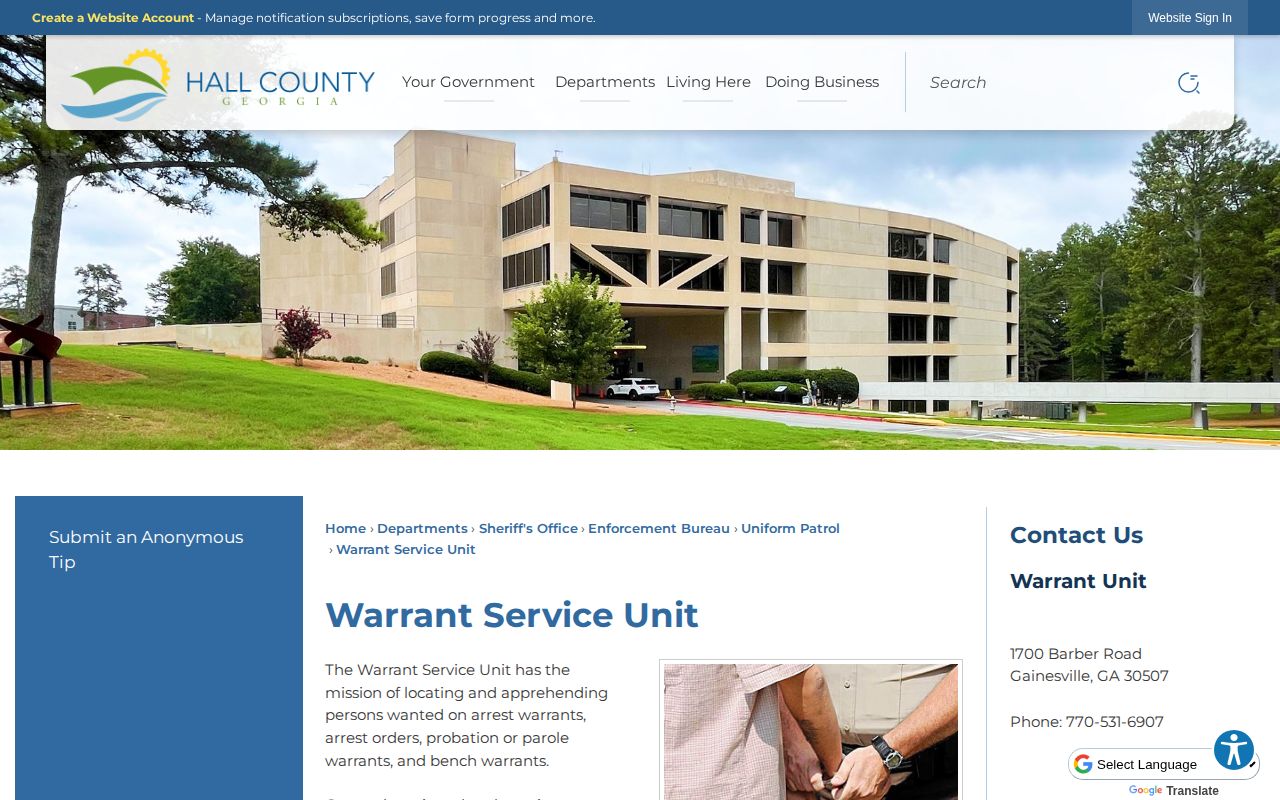
Go through the unit or the court for anything current. A web notice, on its own, confirms nothing.
Hall County Wanted List or Warrant Check
Hall County's public Most Wanted catalog is curated, not complete. No comprehensive public name-search warrant database exists for the county. For a specific warrant question, the sheriff's Warrant Service Unit is the authoritative contact. Magistrate Court handles the early stages, from the warrant itself through first appearance.
Suspect a warrant affects you personally? Use a lawyer or the issuing court for a safe, current answer. Do not test it by approaching a deputy or dodging contact. Someone on the wanted list may end up booked into Hall County Jail. The inmate page is no substitute for an actual warrant check.
Check a Hall County Warrant
Calling beats browsing when the stakes are real. A photo list is a sample, not an index. The Warrant Service Unit page lists 770-531-6907 along with its Barber Road address. For help seeking a warrant, Hall Magistrate Court can be reached at 770-531-6912. A clerk or an attorney can point a case involving a particular person down the right path.
- Gather the person's full name and any date, case, or agency detail that can distinguish similar names.
- Review the official Most Wanted entry, understanding that no result does not clear a person.
- Call the Hall County Warrant Service Unit or contact the issuing court for current confirmation.
- If the question concerns the person asking, use counsel or the court for next steps and do not attempt to evade service.
- After an arrest, check the current Hall County inmate catalog and the court docket separately.
Once a case moves to State or Superior Court, the Hall court docket is the online place to look. Magistrate criminal records are not posted the same way, so a call to the clerk may be needed for those.
Hall County Warrant Types and Court Route
Warrant terms map onto different legal paths, and the Warrant Service Unit's categories are agency labels rather than findings about any person.
| Type | Plain-language meaning |
|---|---|
| Arrest warrant | Authority to take a person into custody based on the issuing process. |
| Arrest order | An order identified by HCSO as part of its service work. |
| Bench warrant | A court-issued order connected to a person's failure to follow a court requirement. |
| Probation or parole warrant | An order tied to supervision, handled through the responsible authority. |
Don't confuse a first appearance with an arraignment. They are different steps. The early hearing happens soon after booking, and Hall Jail handles the transport. The county's court-appearance information lays this out. Once a case moves deeper into State or Superior Court, the Clerk's office becomes the place to look. That split matters for searchers. A warrant question and a question about how a case ended are not the same thing, so chase them separately.
Hall County Wanted Notices and No App
Want a Most Wanted app from the Hall County Sheriff's Office? There isn't one. The Police-to-Citizen catalog runs as a web service only. HCSO does point people to VINE for custody-status alerts, but VINE tracks bookings and releases. It won't show you a wanted list, a warrant search, or booking photos.
Social media fills part of the gap. County and agency accounts sometimes post wanted notices there. Just remember those posts are selective, and they can be edited or pulled without warning. When you spot a name, save the source and verify it with the Warrant Service Unit. A social post, a Most Wanted entry, and a confirmed warrant each tell you something different.
Ready to report someone? The official anonymous tip form is the route. It sends information to law enforcement. It is not a way to reach a wanted person directly.
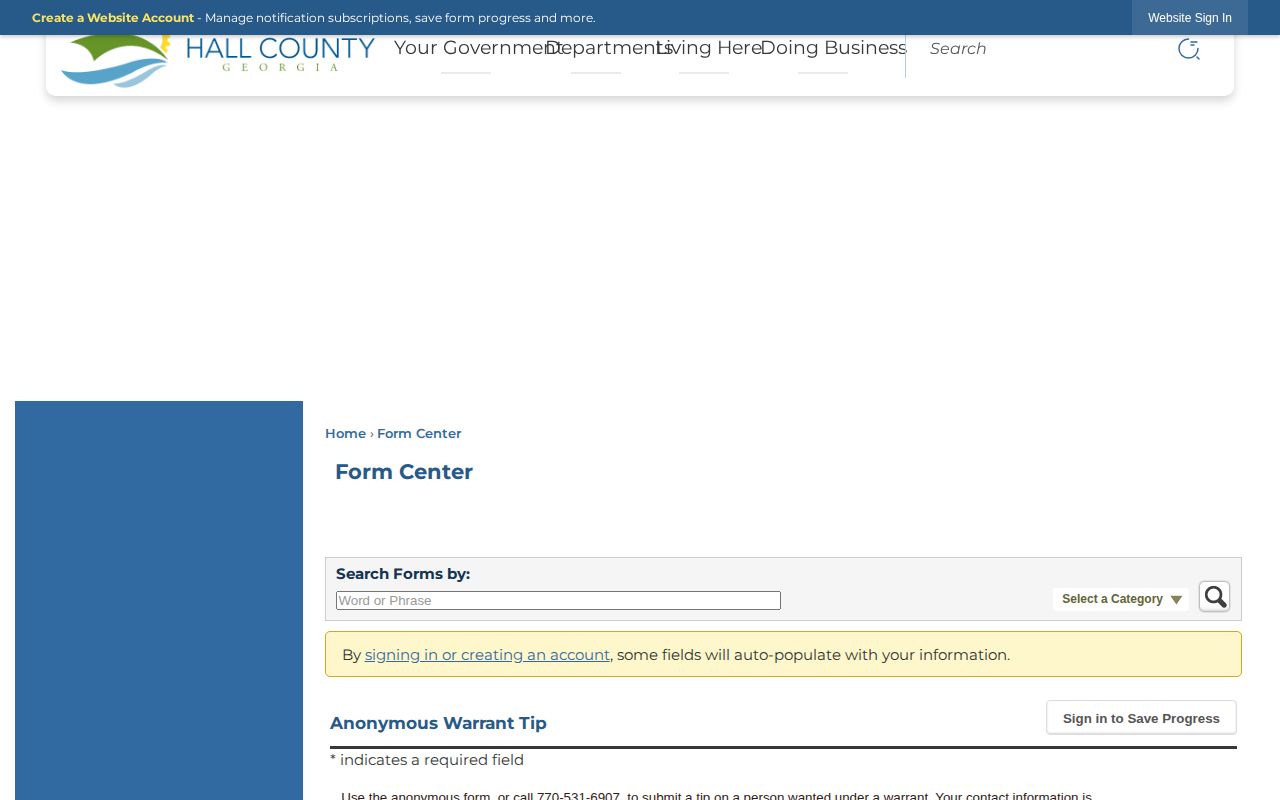
The tip form leaves contact fields optional, so you can stay anonymous. No reward is attached, and filing a tip neither confirms a warrant nor settles what happened in a case.
Hall County Warrant Service Activity
The Hall County Jail Bureau says its Warrant Service Unit serves about 600 arrest warrants each month. That number is activity, nothing more. It does not count unique people, open cases, or outstanding warrants. So it tells you nothing about the size of the Most Wanted list itself.
The unit's work spans several paper types. Arrest warrants, arrest orders, probation and parole warrants, and bench warrants all pass through it. The public catalog may reflect only a slice of that total, and how often it refreshes varies. For a live question, contact the Warrant Service Unit directly and treat the monthly figure as background rather than a search result.
A warrant authorizes an arrest process. It is not a court finding about anyone. After booking, current custody shows up in the Hall County inmate catalog, and the case itself moves to whichever court has jurisdiction, where charges can shift or resolve over time.
Hall County Wanted Notice and Disposition
After a wanted notice, the smart move is checking custody and court records. First appearance is an early hearing held after booking. It is not an arraignment. Neither hearing ends the case. Hall Magistrate Court issues warrants and holds first appearances, while State and Superior Court records carry the criminal cases filed later within their jurisdictions.
A listed charge is a starting point. A person might sit in jail, post bond, or get transferred while the prosecutor and court work through the matter. Outcomes such as dismissal, a plea, or a conviction may never appear on an old wanted-page capture. Confirm current status with HCSO and the court. Note the date on each source you consult.
State custody is a separate track. If the person ends up in a Georgia prison, the Georgia Department of Corrections offender search answers that corrections question, not a Hall County warrant question.
Federal custody runs on its own rails too. Use the BOP locator's record notes and its FOIA route for those questions rather than the local wanted catalog. The U.S. Marshals prisoner-photo policy does not create a public pretrial roster. No federal source will confirm a Hall warrant or a local case outcome.